
Ruby
Cosmic Ray Effects on Gemstones
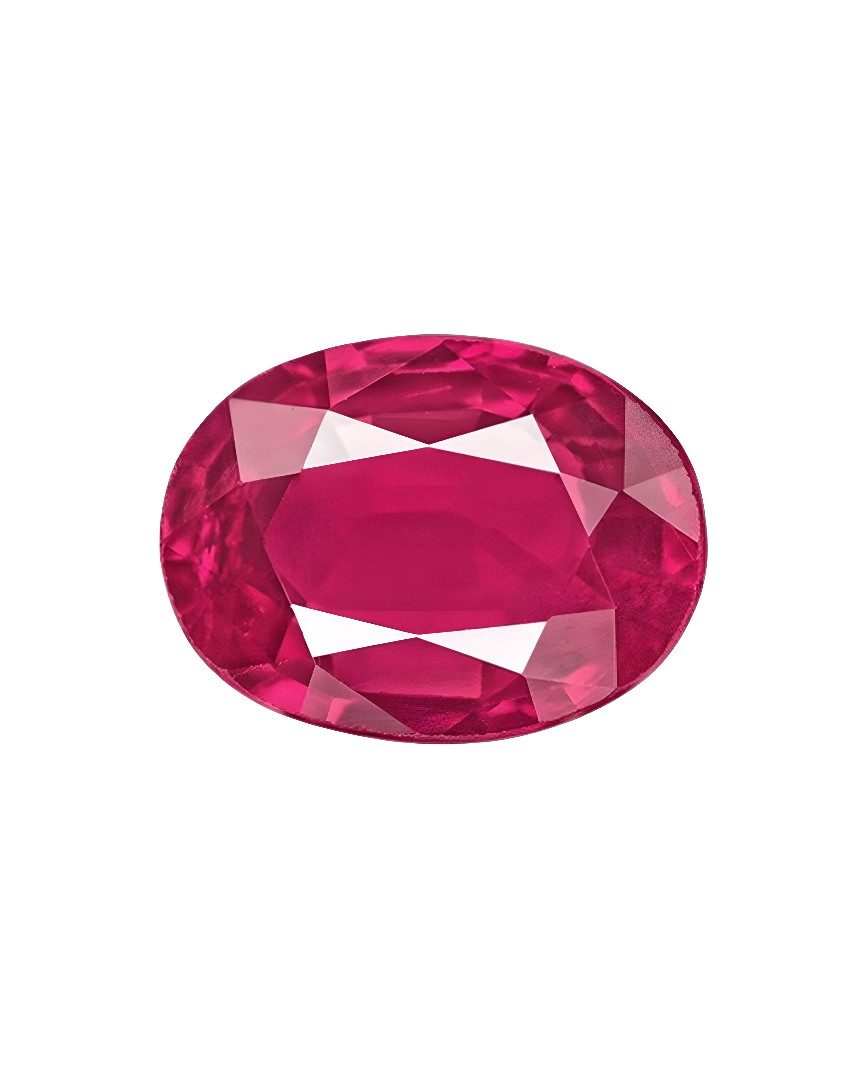
Ruby
Ruby consists of Chromium and corundum. It acts as an antenna for red cosmic rays. Our sun rules the ruby. It can help cure leprosy, ulcers, fevers, and hearing and bone troubles. It warns people of many dangers. It increases dignity, respect, and honor and ensures a high status in life.
Value
Rubies are the most valuable members of the corundum family. Large gem quality rubies can be more valuable than comparably sized diamonds and are certainly rarer. There is a relative abundance of smaller, (1-3 carat,) blue sapphires compared to the scarcity of even small gem quality rubies, making even these smaller stones relatively high in value.
Stones of Burmese origin generally command the highest prices. The vast majority of rubies are “native cut” in the country of origin. High value ruby rough is tightly controlled and rarely makes its way to custom cutters.
Sinkankas and Miller in the Standard Catalog of Gem Values, 2nd. Ed. list a wide range of wholesale prices for faceted gem rubies. Prices are dependent on origin, color, size, and clarity: from a low of $100 to $15,000/ ct maximum.
Ruby is the red variety of corundum, while all other colors are called sapphires. Its color ranges from pinkish to brownish red, influenced by chromium and iron. The stone’s origin (like Burmese or Thai) can affect its appearance and is often used in color descriptions.
Most rubies are heat-treated to enhance clarity and color. Simple heating is widely accepted if disclosed, but other treatments like glass filling or diffusion can reduce value. Rubies are hard and durable, ideal for jewelry, and often show pleochroism (color changes with angle). Many also fluoresce under UV light, especially Burmese rubies.
Synthetic rubies have been made since the early 1900s and are sometimes mistaken for natural stones. Lower-quality ruby is used in carvings and beads, and can even produce star effects (asterism). Rubies have a rich history, often believed to protect the wearer from harm.
Facts About Rubies
CHEMISTRY
Al2O3
CRYSTALLOGRAPHY
Hexagonal
HARDNESS
9
SPECIFIC GRAVITY
3.99 - 4.0
CLEAVAGE
None
HEAT SENSITIVE
No
WEARABILITY
Excellent
INSTRUCTIONS
None
| Element | Mass of element in a 70-kg person | Volume of purified element | Element would comprise a cube this long on a side |
|---|---|---|---|
| oxygen | 43 kg | 37 L | 33.5 cm |
| carbon | 16 kg | 7.08 L | 19.2 cm |
| hydrogen | 7 kg | 98.6 L | 46.2 cm |
| nitrogen | 1.8 kg | 2.05 L | 12.7 cm |
| calcium | 1.0 kg | 645 mL | 8.64 cm |
| phosphorus | 780 g | 429 mL | 7.54 cm |
| potassium | 140 g | 162 mL | 5.46 cm |
| sulfur | 140 g | 67.6 mL | 4.07 cm |
| sodium | 100 g | 103 mL | 4.69 cm |
| chlorine | 95 g | 63 mL | 3.98 cm |
| magnesium | 19 g | 10.9 mL | 2.22 cm |
| iron | 4.2 g | 0.53 mL | 8.1 mm |
| fluorine | 2.6 g | 1.72 mL | 1.20 cm |
| zinc | 2.3 g | 0.32 mL | 6.9 mm |
| silicon | 1.0 g | 0.43 mL | 7.5 mm |
| rubidium | 0.68 g | 0.44 mL | 7.6 mm |
| strontium | 0.32 g | 0.13 mL | 5.0 mm |
| bromine | 0.26 g | 64.2 µL | 4.0 mm |
| lead | 0.12 g | 10.6 µL | 2.2 mm |
| copper | 72 mg | 8.04 µL | 2.0 mm |
| aluminum | 60 mg | 22 µL | 2.8 mm |
| cadmium | 50 mg | 5.78 µL | 1.8 mm |
| cerium | 40 mg | 4.85 µL | 1.7 mm |
| barium | 22 mg | 6.12 µL | 1.8 mm |
| iodine | 20 mg | 4.06 µL | 1.6 mm |
| tin | 20 mg | 3.48 µL | 1.5 mm |
| titanium | 20 mg | 4.41 µL | 1.6 mm |
| boron | 18 mg | 7.69 µL | 2.0 mm |
| nickel | 15 mg | 1.69 µL | 1.2 mm |
| selenium | 15 mg | 3.13 µL | 1.5 mm |
| chromium | 14 mg | 1.95 µL | 1.3 mm |
| manganese | 12 mg | 1.61 µL | 1.2 mm |
| arsenic | 7 mg | 1.21 µL | 1.1 mm |
| lithium | 7 mg | 13.1 µL | 2.4 mm |
| cesium | 6 mg | 3.2 µL | 1.5 mm |
| mercury | 6 mg | 0.44 µL | 0.8 mm |
| germanium | 5 mg | 0.94 µL | 1.0 mm |
| molybdenum | 5 mg | 0.49 µL | 0.8 mm |
| cobalt | 3 mg | 0.34 µL | 0.7 mm |
| antimony | 2 mg | 0.30 µL | 0.7 mm |
| silver | 2 mg | 0.19 µL | 0.6 mm |
| niobium | 1.5 mg | 0.18 µL | 0.6 mm |
| zirconium | 1 mg | 0.15 µL | 0.54 mm |
| lanthanium | 0.8 mg | 0.13 µL | 0.51 mm |
| gallium | 0.7 mg | 0.12 µL | 0.49 mm |
| tellurium | 0.7 mg | 0.11 µL | 0.48 mm |
| yttrium | 0.6 mg | 0.13 µL | 0.51 mm |
| bismuth | 0.5 mg | 51 nL | 0.37 mm |
| thallium | 0.5 mg | 42 nL | 0.35 mm |
| indium | 0.4 mg | 55 nL | 0.38 mm |
| gold | 0.2 mg | 10 nL | 0.22 mm |
| scandium | 0.2 mg | 67 nL | 0.41 mm |
| tantalum | 0.2 mg | 12 nL | 0.23 mm |
| vanadium | 0.11 mg | 18 nL | 0.26 mm |
| thorium | 0.1 mg | 8.5 nL | 0.20 mm |
| uranium | 0.1 mg | 5.3 nL | 0.17 mm |
| samarium | 50 µg | 6.7 nL | 0.19 mm |
| beryllium | 36 µg | 20 nL | 0.27 mm |
| tungsten | 20 µg | 1.0 nL | 0.10 mm |
Raw data from which this table was made are from Emsley, John, The Elements, 3rd ed., Clarendon Press, Oxford, 1998. This is a great trove of information, which I highly recommend for anyone wishing to learn more about the elements.
Introduction
By wearing properly prescribed gemstones under proper supervision, you can benefit from the natural healing characteristics of Vedic astrological gemstones. We do not recommend these Vedic astrological gemstones to be applied in lieu of necessary medical attention. By no means is this information a self-help panacea. However, we do recommend the application of Vedic astrological gemstones in efforts to reduce discomfort in a natural and time-demanding situation.
However, we have empirical evidence that utilizes the examination of your horoscope and family background for a prescription. Our ‘dosages’ are monitored and are based on the size and type of gemstones.The ancient scientific scriptures consistently mention the relationship between color, planets, and gemstones. With the almost sacred color stratification, ROYGBIV (Red, Orange, Yellow, Green, Blue, Indigo, Violet), we see the correlation perfectly. The cosmic rays that manifest themselves in various wavelengths (colors) have unique affects on the health of our mind and body. The purest of the ROYGBIV rays resides concentrated in precious gems, and so, the gems are of great curative value.
Note
Oxygen is the most abundant element in the earth’s crust and in the body. The body’s 43 kilograms of oxygen is found mostly as a component of water, which makes up 70% of total body weight. Oxygen is also an integral component of all proteins, nucleic acids (DNA and RNA), carbohydrates, and fats.
Rubidium is the most abundant element in the body (0.68 g) that has no known biological role (silicon, which is slightly more abundant, may or may not have a metabolic function). Vanadium is the body’s least abundant element (0.11 mg) that has a known biologic role, followed by cobalt (3 mg), the latter being a constituent of vitamin B12.
The last of the body’s elements to be discovered was fluorine, by Moissan in 1886.