
Pearl
Cosmic Ray Effects on Gemstones
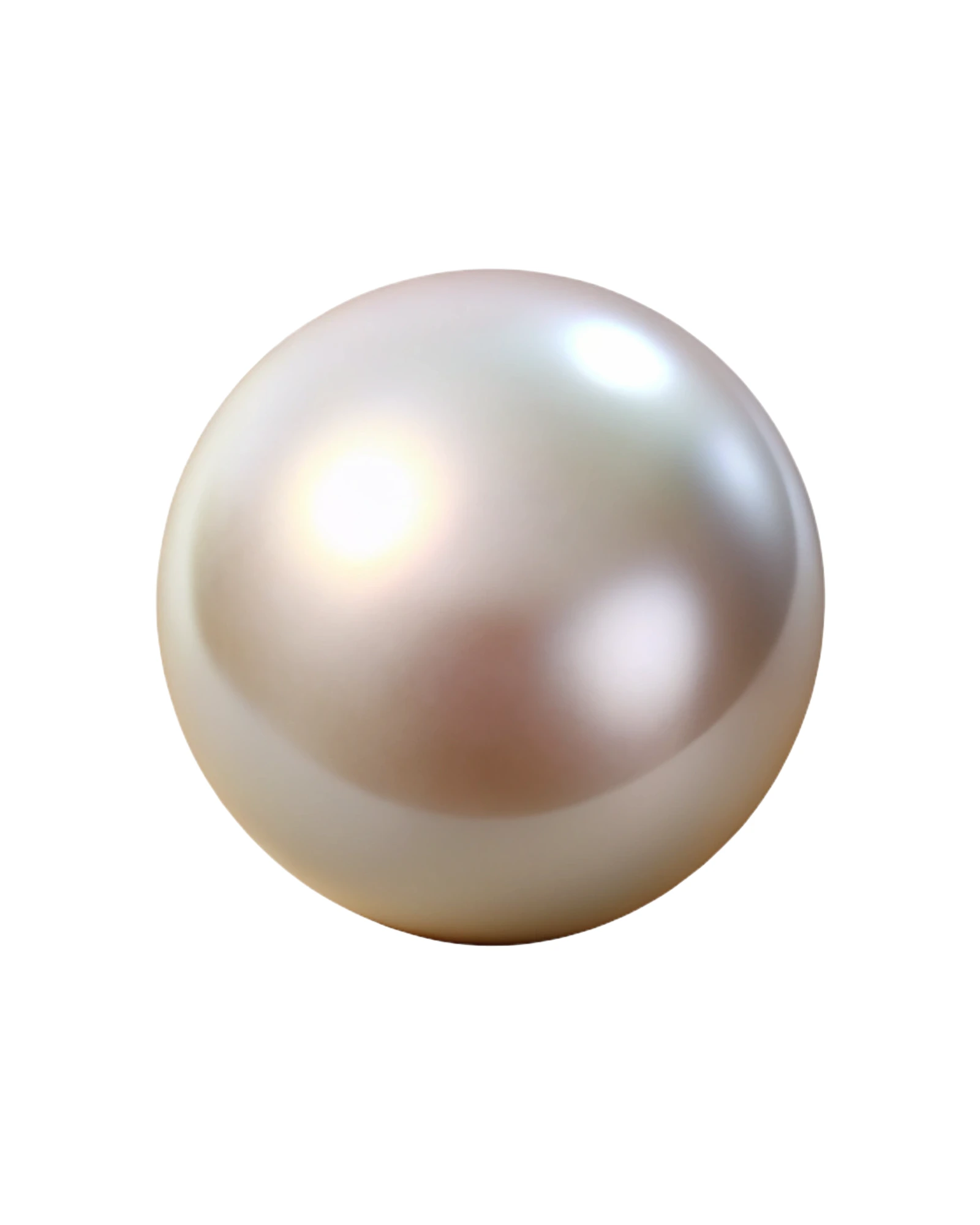
Pearl
Pearl acts as an antenna toward orange cosmic rays. It is a cold gem ruled by the Moon. It is helpful for persons who suffer from eye troubles, tuberculosis, hysteria, constipation, and cardiac trouble. Pearl is a suitable gem to enhance mental peace and memory recollection. It succeeds in engaging love, attracts affection, and promises conjugal bliss.
Fresh Water Pearls
Pearls are unique among gemstones because they are formed inside living creatures and require no cutting or polishing before use. Traditionally considered a feminine gem, pearls are especially popular with brides and are the official birthstone for June.
Cultured pearls are created by inserting tissue or beads into mollusks, prompting them to form layers of nacre, which gives pearls their luster and iridescence. The culturing process can take 1–3 years depending on conditions.
The freshwater pearl industry began in Japan’s Lake Biwa in the 1920s but has shifted mainly to China due to environmental issues in Japan. The U.S. also contributes, notably from the Tennessee River. Pearl farming is delicate, with only a fraction of mollusks producing gem-quality pearls.
Pearl colors range from white to tan to gray, and enhancements like bleaching or dyeing are common to improve appearance. Shapes vary widely, including baroque, button, rice, and mabe pearls.
Despite their delicate nature, pearls are durable enough for jewelry with proper care. They should be stored separately, kept away from heat, chemicals, and perfumes, and cleaned gently.
Imitation pearls are made from glass, plastic, or shell. With cultured pearl prices low, real pearls are widely accessible. A quick test: real pearls feel gritty when rubbed on teeth, while fakes feel smooth.
Value
The value of a pearl is most related to the thickness and quality of the sacre. Other factors include size, (especially in rounds) shape, and color. In general, the highest prices will be paid for large, bound, well colored, unenhanced gems. Factors that influence value in pearl jewelry pieces would add to these general considerations, quality of stringing and degree of atching in size and color.
Salt Water Pearls
Pearls are one of our most ancient gems with records of commercial harvesting going back 2500 years. Their natural occurrence is very rare, with only one in several million shellfish ever producing a pearl. Oysters are the best-known source, but clams, mussels, and abalone also produce pearls. For a pearl to form an irritant, (usually a grain of sand,) must get deep enough inside a shell, that the animal cannot expel it. The creature’s shell producing system begins coating the irritant with nacre, the shiny substance that you find on the interior of most shells.
Sacre is composed of the mineral aragonite, with an organic binder called conchiolin. The aragonite forms minute crystals with a radial oriented, concentric structure. You can feel the edges of these crystals by rubbing a pearl against your teeth. The tooth test has long been used for pearls. Most of their imitations will feel smooth, rather than gritty, when bubbed against a tooth.
Natural pearls almost disappeared from the market in the late 1800’s due to excessive harvesting. Even today, they are extremely rare and demand a huge ransom. Necessity is the mother of invention and, as pearl sources began to dry up, several enterprising Japanese developed methods of nulturing pearls in oyster farms. Cultured pearl production began in Japan around 1910. tot only does the culturing process provide more pearls, it also allows larger pearls to be produced.
The process involves inserting a mother of pearl seed, along with a piece of tissue, known as the mantel, into the oyster. After surgery, the mysters convalesce in a “hospital” for four to six weeks. They are then transferred to cages between seven and ten feet under water. Here, they are allowed to grow for three to six years.
Freshwater pearl yarms began in Lake Biwa, Japan around 1928. They have the advantages that up to thirty seeds can be inserted in a single clam and the production time is just three years. The term “Biwa” is nearly synonymous with freshwater pearls, out one should be careful about using it if the source is unknown. Freshwater pearl shapes were originally quite irregular, but steady improvements have been made. Today, freshwater pearls vival their saltwater cousins in shape and luster. When reading pearls, it makes no difference if they are from fresh or salt water.
Unfortunately, pollution and illness have greatly reduced the japanese saltwater farms in recent years. However, freshwater yarming is on the rise. Freshwater pearls are being grown all around the world and the quality is constantly improving.
Facts About Rubies
CHEMISTRY
about 82 - 86%, conchiolin 10 - 14%, water 2%.
CRYSTALLOGRAPHY
Aragonite is orthorhombic with crystals radially oriented.
ENHANCEMENTS
Dying & Common
INSTRUCTIONS
Avoid heat, perfumes, cosmetics & all chemicals
HARDNESS
2.6 - 2.78
SPECIFIC GRAVITY
3.99 - 4.0
HEAT SENSITIVE
Yes
WEARABILITY
Good
REFRACTIVE INDEX
1.53 - 1.69
CLEAVAGE
None
| Element | Mass of element in a 70-kg person | Volume of purified element | Element would comprise a cube this long on a side |
|---|---|---|---|
| oxygen | 43 kg | 37 L | 33.5 cm |
| carbon | 16 kg | 7.08 L | 19.2 cm |
| hydrogen | 7 kg | 98.6 L | 46.2 cm |
| nitrogen | 1.8 kg | 2.05 L | 12.7 cm |
| calcium | 1.0 kg | 645 mL | 8.64 cm |
| phosphorus | 780 g | 429 mL | 7.54 cm |
| potassium | 140 g | 162 mL | 5.46 cm |
| sulfur | 140 g | 67.6 mL | 4.07 cm |
| sodium | 100 g | 103 mL | 4.69 cm |
| chlorine | 95 g | 63 mL | 3.98 cm |
| magnesium | 19 g | 10.9 mL | 2.22 cm |
| iron | 4.2 g | 0.53 mL | 8.1 mm |
| fluorine | 2.6 g | 1.72 mL | 1.20 cm |
| zinc | 2.3 g | 0.32 mL | 6.9 mm |
| silicon | 1.0 g | 0.43 mL | 7.5 mm |
| rubidium | 0.68 g | 0.44 mL | 7.6 mm |
| strontium | 0.32 g | 0.13 mL | 5.0 mm |
| bromine | 0.26 g | 64.2 µL | 4.0 mm |
| lead | 0.12 g | 10.6 µL | 2.2 mm |
| copper | 72 mg | 8.04 µL | 2.0 mm |
| aluminum | 60 mg | 22 µL | 2.8 mm |
| cadmium | 50 mg | 5.78 µL | 1.8 mm |
| cerium | 40 mg | 4.85 µL | 1.7 mm |
| barium | 22 mg | 6.12 µL | 1.8 mm |
| iodine | 20 mg | 4.06 µL | 1.6 mm |
| tin | 20 mg | 3.48 µL | 1.5 mm |
| titanium | 20 mg | 4.41 µL | 1.6 mm |
| boron | 18 mg | 7.69 µL | 2.0 mm |
| nickel | 15 mg | 1.69 µL | 1.2 mm |
| selenium | 15 mg | 3.13 µL | 1.5 mm |
| chromium | 14 mg | 1.95 µL | 1.3 mm |
| manganese | 12 mg | 1.61 µL | 1.2 mm |
| arsenic | 7 mg | 1.21 µL | 1.1 mm |
| lithium | 7 mg | 13.1 µL | 2.4 mm |
| cesium | 6 mg | 3.2 µL | 1.5 mm |
| mercury | 6 mg | 0.44 µL | 0.8 mm |
| germanium | 5 mg | 0.94 µL | 1.0 mm |
| molybdenum | 5 mg | 0.49 µL | 0.8 mm |
| cobalt | 3 mg | 0.34 µL | 0.7 mm |
| antimony | 2 mg | 0.30 µL | 0.7 mm |
| silver | 2 mg | 0.19 µL | 0.6 mm |
| niobium | 1.5 mg | 0.18 µL | 0.6 mm |
| zirconium | 1 mg | 0.15 µL | 0.54 mm |
| lanthanium | 0.8 mg | 0.13 µL | 0.51 mm |
| gallium | 0.7 mg | 0.12 µL | 0.49 mm |
| tellurium | 0.7 mg | 0.11 µL | 0.48 mm |
| yttrium | 0.6 mg | 0.13 µL | 0.51 mm |
| bismuth | 0.5 mg | 51 nL | 0.37 mm |
| thallium | 0.5 mg | 42 nL | 0.35 mm |
| indium | 0.4 mg | 55 nL | 0.38 mm |
| gold | 0.2 mg | 10 nL | 0.22 mm |
| scandium | 0.2 mg | 67 nL | 0.41 mm |
| tantalum | 0.2 mg | 12 nL | 0.23 mm |
| vanadium | 0.11 mg | 18 nL | 0.26 mm |
| thorium | 0.1 mg | 8.5 nL | 0.20 mm |
| uranium | 0.1 mg | 5.3 nL | 0.17 mm |
| samarium | 50 µg | 6.7 nL | 0.19 mm |
| beryllium | 36 µg | 20 nL | 0.27 mm |
| tungsten | 20 µg | 1.0 nL | 0.10 mm |
Raw data from which this table was made are from Emsley, John, The Elements, 3rd ed., Clarendon Press, Oxford, 1998. This is a great trove of information, which I highly recommend for anyone wishing to learn more about the elements.
Introduction
By wearing properly prescribed gemstones under proper supervision, you can benefit from the natural healing characteristics of Vedic astrological gemstones. We do not recommend these Vedic astrological gemstones to be applied in lieu of necessary medical attention. By no means is this information a self-help panacea. However, we do recommend the application of Vedic astrological gemstones in efforts to reduce discomfort in a natural and time-demanding situation.
However, we have empirical evidence that utilizes the examination of your horoscope and family background for a prescription. Our ‘dosages’ are monitored and are based on the size and type of gemstones.The ancient scientific scriptures consistently mention the relationship between color, planets, and gemstones. With the almost sacred color stratification, ROYGBIV (Red, Orange, Yellow, Green, Blue, Indigo, Violet), we see the correlation perfectly. The cosmic rays that manifest themselves in various wavelengths (colors) have unique affects on the health of our mind and body. The purest of the ROYGBIV rays resides concentrated in precious gems, and so, the gems are of great curative value.
Note
Oxygen is the most abundant element in the earth’s crust and in the body. The body’s 43 kilograms of oxygen is found mostly as a component of water, which makes up 70% of total body weight. Oxygen is also an integral component of all proteins, nucleic acids (DNA and RNA), carbohydrates, and fats.
Rubidium is the most abundant element in the body (0.68 g) that has no known biological role (silicon, which is slightly more abundant, may or may not have a metabolic function). Vanadium is the body’s least abundant element (0.11 mg) that has a known biologic role, followed by cobalt (3 mg), the latter being a constituent of vitamin B12.
The last of the body’s elements to be discovered was fluorine, by Moissan in 1886.